- Seeing is Selling
- Posts
- AI in Visualisation: Power (Not Magic)
AI in Visualisation: Power (Not Magic)
Why expertise and process still matter in an age of generative AI

Richard Birket
September 12, 2025 • Estimated Reading Time: 2 minutes
Generative AI: More Than a One-Click Wonder
Generative AI has burst into the creative industries with dazzling headlines. Stunning concept images appear in our feeds every day, often with the implication that they were conjured from thin air — a single text prompt, a couple of clicks, instant brilliance.
But the reality for those of us working in architectural visualisation is far more nuanced. At Blink Image Limited, we’re excited by the power of AI. We use it every day to push creative boundaries. But we also know it’s not magic. Like any tool, it only delivers real value in skilled hands, and only when it’s combined with the disciplined workflows our property and design clients expect.

Delivering a drone shot where drone is impossible (under the Heathrow flightpath) utilising both AI and traditional visualisation workflows. Created for Tritax Big Box
The Myth of Effortless AI
Social media thrives on the “best shot.” Just as a photographer shares the perfect frame rather than the hundreds they took to get there, online AI posts tend to showcase the one iteration — out of perhaps a hundred — that actually worked. This creates an illusion of ease, hiding the hours of experimentation, refinement and (if we’re honest) swearing that go into achieving a usable result.
Another layer of the illusion: creators take for granted their own skills. Owning a £30k camera doesn’t make someone a photographer. Likewise, generative AI undirected by an experienced eye is unlikely to produce a meaningful, on-brief image.
And of course, there’s a commercial motive. LinkedIn posts promising “You too can make results like this — just subscribe to my newsletter” are selling the dream of effortless creation. But it really is just a dream.
Reality Check: Visualisation for the Built Environment
For most AI art online, “good enough” means “looks cool.” In property and design, that’s not good enough. Our images must show precisely what is proposed to be built. There is no room for random hallucination.
That’s why our AI workflows at Blink Image are anything but one-prompt wonders. We combine multiple models, steps and quality checks to control every aspect of the result — from composition and lighting to material accuracy and context.
And crucially, we blend these AI tools with our traditional skillset: 3D modelling and rendering, post-production, a deep understanding of drawings and design intentions, and the craft of visual storytelling that gets stakeholders on board.
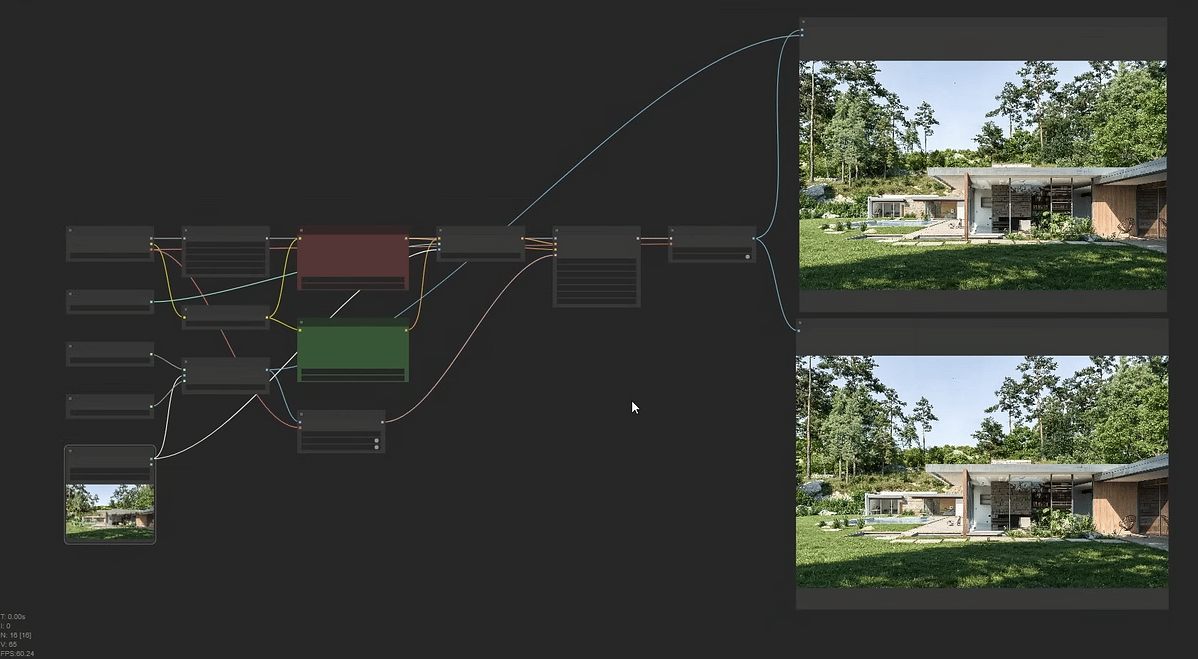
To get the control we need with AI requires ‘getting under the hood,’ combining different AI tools and integrating with more traditional workflows
Experience Still Matters
Generative AI is a powerful accelerator. It can speed up ideation, fill in gaps and open up new possibilities. But it does not replace experience, judgement or dialogue with the client.
In our hands, AI helps us iterate faster and present richer options. In inexperienced hands, it can produce misleading or off-brief imagery. The difference is the expertise behind the screen — exactly as it always has been with any professional tool.
What This Means for Developers and Architects
For you, as a property developer or architect, the takeaway is simple:
AI is a tool, not a shortcut. Used well, it can give you more options and fresher ideas earlier in the process.
Accuracy is still king. Always work with partners who understand your design intentions and can control the output.
Experience is irreplaceable. The value lies in teams who can combine new technology with traditional craft.