- Seeing is Selling
- Posts
- How AI benefits visual strategy
How AI benefits visual strategy
How AI Tools Are Enhancing, Not Replacing, Architectural Storytelling

Richard Birket
August 29, 2025
The rise of artificial intelligence has been compared to the industrial revolution - such is its capacity to disrupt the way we live and work. No industry is immune, and the design community has felt the tremors perhaps more than most.
No industry is unaffected and its arrival has been met with a great deal of wariness by the design community in particular who, until relatively recently, would have felt confident that the realm of creativity would be safe from AI's algorithms.
Recent developments upended that theory, to much alarm with progress in the fields of image and video generating AIs occurring at breakneck speed.
As writer and artist Joanna Maciejewska aptly put it:
"I want AI to do my laundry and dishes so that I can do art and writing - not for AI to do my art and writing so that I can do my laundry and dishes."
But having made the decision some time back that the only sensible course was to ride the AI wave, or risk being run over by it, the conclusion we have come to at Blink Image is somewhat different: it's just another tool. One with the potential to take our work to the next level to be sure, but in the same way that giving a £20,000 camera to your Gran won't result in professional grade photography, (depending who your Gran is) AI alone will not get you close to the professional output needed to achieve your development goals if there's no expert driving it.
So what does AI actually offer to our clients?
Probably the most significant area in which it has proved its potential so far is in the way it helps us to leverage our core CGI work to generate entirely new forms of visual collateral.
Visual collateral is obviously the life blood of property marketing campaigns, especially in an increasingly "digital first," social media savvy age, and the ability to generate a host of genuinely different angles, and fresh dynamic new ways of looking at your scheme vision is essential to making stronger visual campaigns that command attention, boost engagement, and reinforce your development vision across all touchpoints.
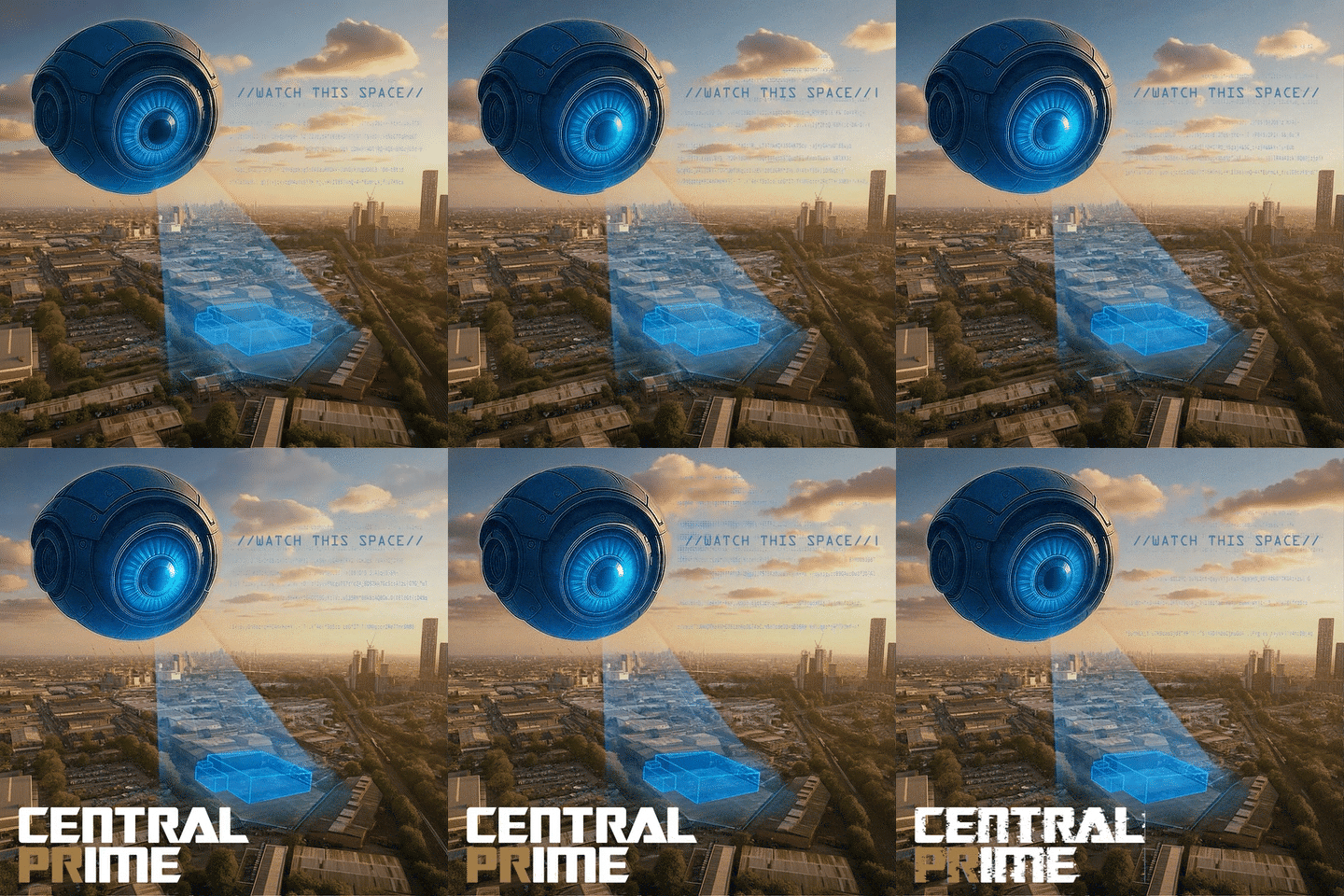
Integrating AI into our workflows has helped us to create more memorable and innovative pieces of content for our clients. Like this Virtual Impact ‘Coming Soon’ Ad for Central Prime, Goya Developments | © Blink Image Limited
Through AI-enhanced workflows, we can animate static CGIs - turning them into short video clips with camera movement, animated elements like swaying trees, and even subtle human presence. When executed properly, the effect is genuinely compelling. It adds emotional resonance and brings a scheme to life in a way that static images alone simply can't.

Prime residential CGI for Dukelease which we have brought to life through our AI workflow | © Blink Image Limited
Another area it has proved a powerful tool is in the area of manipulating photography and video, allowing us to potentially extend photographs, remove unwanted objects from them and even change the angle.
These enhancements aren’t just for show—they have practical implications. They allow us to repurpose existing assets and avoid costly or time-consuming reshoots, all while maintaining visual fidelity and creative integrity.
In Summary
AI isn’t here to replace creativity - it’s here to empower it. For developers and architects aiming to communicate complex visions with clarity and impact, it’s a game-changer. But like any advanced tool, its true value is only unlocked when it's guided by experience, strategy, and design intelligence.
At Blink Image, we see AI not as a threat, but as an opportunity - to push creative boundaries, to work smarter, and to deliver more compelling, cost-effective visual content for our clients.