- Seeing is Selling
- Posts
- The UK’s Fastest-Growing Asset Class Has a Visualisation Problem
The UK’s Fastest-Growing Asset Class Has a Visualisation Problem
Because the building isn’t the story

Richard Birket
March 20, 2026 • Estimated Reading Time: 3 minutes
Data centres are being built across the UK at a rate not seen before.
The UK - and London in particular - is one of the largest data centre markets in Europe, and the pace of development is accelerating. These are major infrastructure projects - in some cases reaching the scale of nationally significant infrastructure - and they are becoming an increasingly important part of the built environment.
They are also, almost without exception, designed to look like as little as possible!
No windows. No street-level activity. No public-facing architecture. A large, secure box - which is precisely what the brief requires.
And yet, from a visual perspective, they present a very particular problem.

Cody Park © Blink Image Limited
Three Audiences, Three Different Briefs
A data centre development typically needs to speak to three audiences - and each needs to see something quite different.
Planning authorities - often at a regional or national level - need to understand how the scheme sits within its landscape, how it appears from key viewpoints, and how its environmental impacts are addressed. Verified views, landscape visual impact assessments, and accurate context CGIs are the tools that carry weight here.
Investors and occupiers need to understand what is inside: power infrastructure, cooling systems, resilience, security, and increasingly, sustainability performance. The interior of a data centre is almost entirely functional, and presenting it clearly requires a different approach from a commercial office or industrial unit. The “hero image” might even be a server hall, a cooling plant, or a power substation - none of which are conventionally what you might call “photogenic”.
Local communities are often the most sensitive audience. A large, windowless building appearing at the edge of a settlement or in open countryside raises understandable concern. The visual strategy here needs to be clear and credible - showing the scale of the building, its landscape mitigation, and how it sits within its surroundings, without attempting to disguise what is, by definition, a substantial piece of infrastructure.

Manor Farm - Power, cooling and location © Blink Image Limited
The Building Is Not the Story
The honest answer is that no visualisation, however well executed, will make a large featureless box beautiful.
That is not a failure of craft - it is simply the nature of the building type. Attempts to dress it up as something it isn’t tend to produce imagery that sophisticated audiences distrust.
The more useful question is: what is the story, if it isn’t the architecture?
Most of what we rely on daily - payments, logistics, communication, streaming - depends on infrastructure housed in buildings like this. The story of a data centre is not what it looks like, but what the world looks like because it exists.
The honest answer is that no visualisation, however well executed, will make a large featureless box beautiful.
That is a narrative that can be communicated effectively, and architectural film is often the right tool - particularly where the story is about systems, infrastructure and impact rather than form.
A well-constructed film that starts with everyday activity and traces it back to the building is doing something an exterior CGI cannot. It connects the abstract to the physical.
There is also a local dimension that often gets overlooked. While operational employment is relatively limited compared to other asset classes, data centre developments still generate construction jobs, ongoing technical and facilities roles, and wider economic activity in the surrounding area. Communicating that clearly can shift the conversation from “what will we have to look at” to “what does this bring.”

Complex messages = Complex Storyboarding - NIC Film © Blink Image Limited
Showing What Matters When the Building Hides Everything
The features that make a data centre commercially compelling are almost entirely invisible from the outside.
Power capacity. Cooling efficiency. Connectivity. Security. Carbon performance.
These are the criteria occupiers and investors evaluate, and none of them are particularly legible in a standard exterior CGI.
The response is a visual strategy that extends beyond the building envelope.
Internal CGIs of server halls and infrastructure spaces.
Diagrams and animations that explain power flow, cooling systems, and resilience.
Aerial views that show proximity to grid connections, fibre routes, and transport infrastructure.
Sustainability communicated through the design itself - solar coverage, drainage strategies, biodiversity planting - rather than graphic overlays.
This requires a different kind of briefing conversation from a typical commercial scheme.
What does an occupier need to understand before committing?
What does a planning inspector need to see to feel confident?
What will reassure a local community that the scheme has been designed with care?
Answering those questions is where the real value of visualisation is defined.
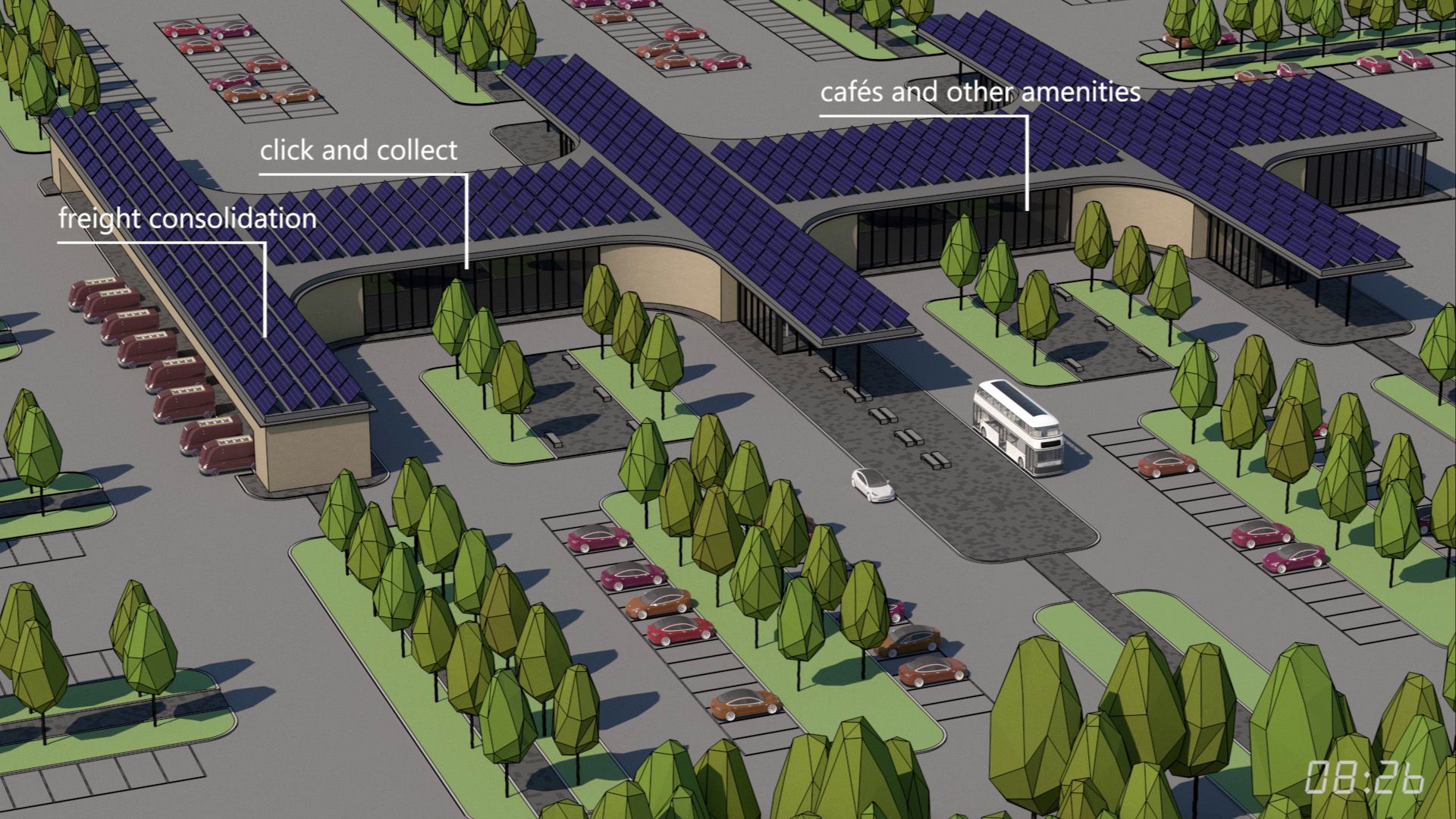
The future of transportation in Oxford - NIC Film screenshot © Blink Image Limited
And Then There’s the Longer Horizon
If the pace of data centre development on the ground feels significant, the longer-term direction of travel is even more ambitious.
There is growing discussion - from companies such as SpaceX and NVIDIA - about the possibility of data processing infrastructure moving into orbit. Much of this remains speculative, and timelines are uncertain, but the underlying challenge is clear: demand for computing capacity is increasing faster than traditional infrastructure can easily support.
Whether that future remains grounded or extends beyond it, the role of visualisation will only become more complex.
The first fully realised visual narrative for this kind of infrastructure has almost certainly not been defined yet. It will be interesting to see who defines it.

Falcon Heavy landing - "Photo by SpaceX on Unsplash"
Data centres are not a niche. They are core infrastructure, and they are being delivered at increasing scale across the UK.
If you are working on a data centre project - whether at planning stage, investor presentation stage, or community consultation - the visualisation brief is worth getting right from the outset.
We would be glad to talk through what your scheme needs.
[email protected]
07777 146 495